As cities and public organisations increasingly explore how AI can support services, information and citizen interaction, a key question is often overlooked: Who are we designing these systems for, and what might we be missing?
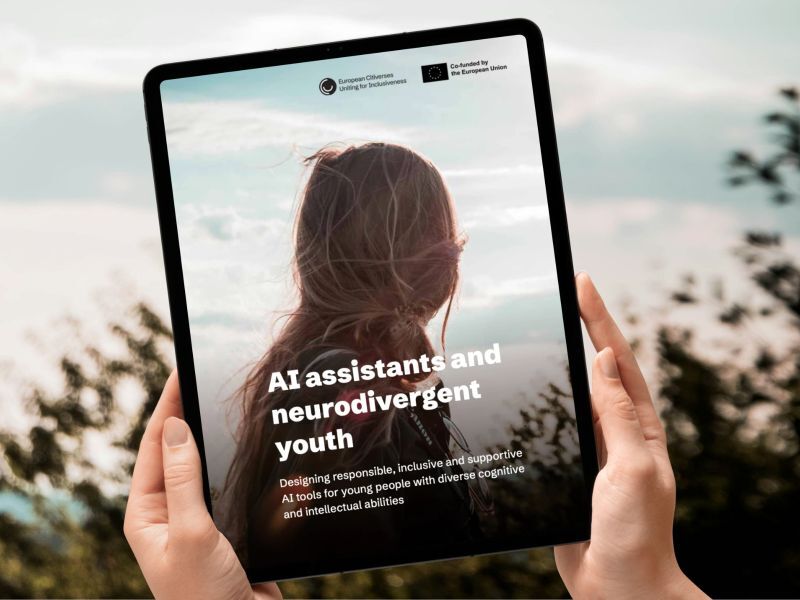
A new report from European Citiverses Uniting for Inclusiveness explores this question through the experiences and needs of neurodivergent young people and young people with intellectual disabilities. It looks at what responsible and inclusive AI assistants could mean, and what the needs of this group can teach us about designing AI more broadly.
The report will be highlighted during OASC’s webinar on AI & Ethics on 13 October, bringing together cities, researchers, practitioners and industry to discuss how AI can be developed and used responsibly in communities. The panel discussion will connect questions around AI ethics with practical experiences from initiatives working with AI, Local Digital Twins and the CitiVerse ecosystem.
The report combines a thorough review of existing research with interviews with parents and guardians of young people aged 11–20 with neurodevelopmental profiles and/or intellectual disabilities.
Based on this work, it offers insights that can help designers, public-sector organisations and decision-makers shape digital services and technologies. At its core is a simple question:
What might we discover if we start with people whose needs are most likely to be overlooked?
This connects to the principle of universal design: rather than designing for an imagined “average” user and adapting afterwards, consider a wider range of needs from the beginning.
For cities and public organisations, this is not only a question of how an AI tool works. It is also about whose needs are considered when technologies are designed, commissioned, procured and evaluated, and where responsibility for accessibility and safe use is placed.
"Technology does not become inclusive simply because it is available to everyone. Inclusion needs to be considered in how we design, build and govern it. Voices from families of young people whose needs are often overlooked can show what our systems are missing. Their experiences make some things clearer, such as why responsibility for AI services must be shared across the whole ecosystem, from those who design and build AI to those who commission and govern it", says Jenny Lindström Beijar, Founder of Our Normal and co-author of the report.
Read the report
About the report
"AI assistants and neurodivergent youth – Designing responsible, inclusive and supportive AI tools for young people with diverse cognitive and intellectual abilities” is produced by Our Normal Association as part of European Citiverses Uniting for Inclusiveness project.
The report suggests ten themes for responsible and inclusive AI design, from personalisation and accessible interaction to natural pauses and ethical safeguards. Each theme includes concrete considerations for those who design, procure and regulate AI tools.
Contact information
Jenny Lindström Beijar, Founder of Our Normal and co-author of the report
Mail: jenny@ournormal.org
Phone: +46 733 988 289
Anna Wennblad, Project Manager, European Citiverses Uniting for Inclusiveness project
Mail: anna.wennblad@lindholmen.se
Phone: +46 (0)708 130689